

There's a version of collecting that's really just accumulating. This is about the other kind.
At some point in any serious vinyl collection, a line gets crossed. The shelf fills. A stack forms on top of the shelf. A crate appears beside it, then another. Records migrate to the spare room. You stop being able to find things quickly. You start buying duplicates because you couldn't remember if you already owned something.
This is not what collecting is supposed to feel like.
The word "collection" implies curation — a considered group of things, chosen for reasons, arranged with intention. What most of us end up with, if we're not deliberate about it, is closer to an archive. Or a hoarding problem with better taste.
The distinction matters because the two relationships with objects are completely different. One is active. You know what you have. You revisit it. You make decisions. The other is passive — you own things, but they don't quite belong to you anymore. They belong to the pile.
The problem with more
The default assumption in vinyl record storage is that capacity is the goal. Bigger shelves. More units. Enough room for the collection to keep growing without intervention. And yes, eventually you'll need the space. But making capacity the primary design driver gets the logic backwards.
The right question isn't how much can I store? It's which records do I actually play?
For most collectors, the honest answer is: a fraction. There's an active rotation — the records you return to, the ones you pull out for guests, the ones that mark a mood or a season. Then there's a wider catalogue — important to own, played occasionally. Then there's everything else. The purchases you regret a little. The ones that haven't made it out of the sleeve in three years. The ones you bought because they seemed essential and turned out not to be.
Most vinyl record storage systems treat all three categories the same way. They're shelved together, sorted alphabetically or by genre, taking up identical space regardless of how much they actually matter to you.
What the curators figured out
The interesting shift happens when you stop trying to accommodate everything and start making choices about what belongs.
This is what galleries do. Not every work in a collection gets displayed — it gets rotated, evaluated, given space when it earns space. The permanent collection at any serious gallery is far larger than what's on the walls at any given time. The selection is the art.
The same logic applies to a vinyl collection, and to the space it lives in. When you own fewer records — or at least display fewer actively — each one has to carry more weight. The covers face out. The albums you've chosen to keep within reach are, by definition, the ones you value most. The experience of sitting down to choose a record changes when everything on the shelf is something you actually want to play.
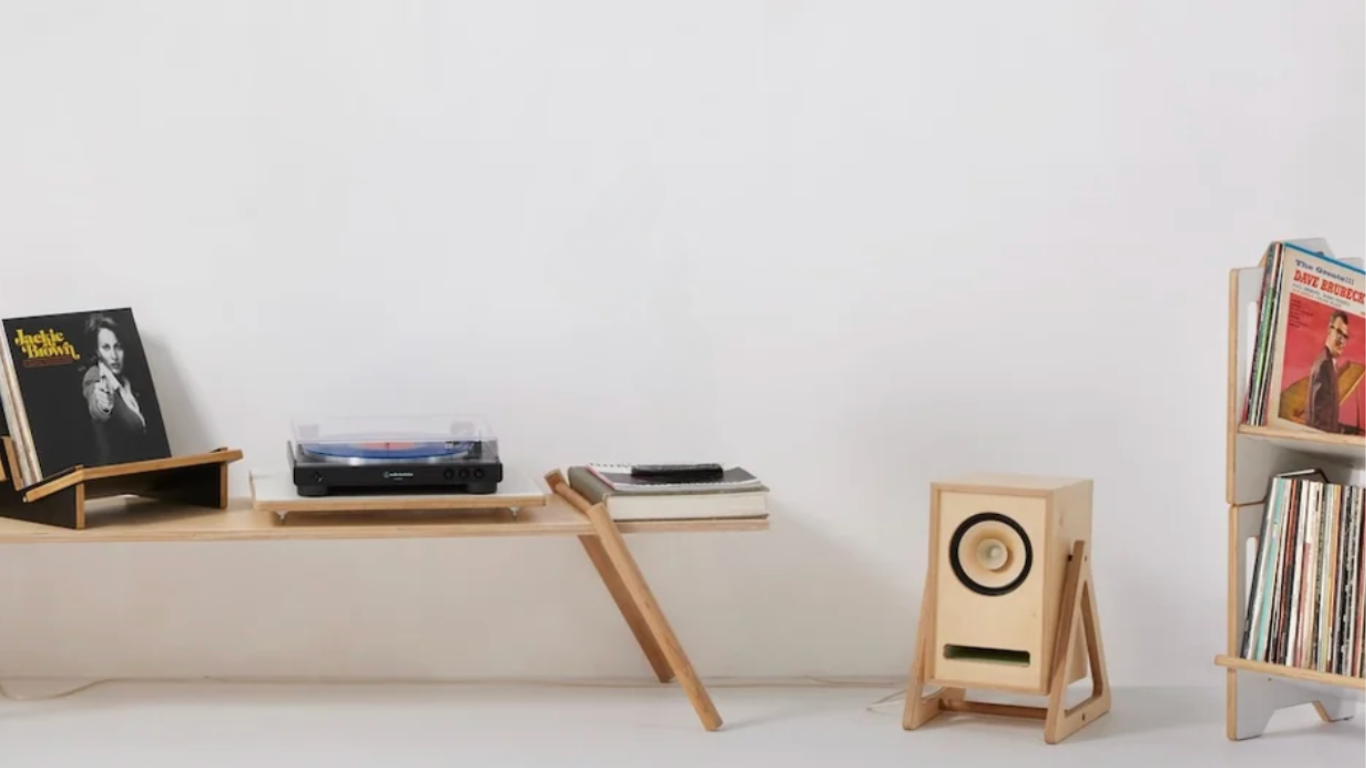
The physical environment follows suit. When the collection is considered, the room can be too. Well-designed vinyl record shelving stops being just a storage solution — it becomes part of how the room looks and feels. The records are the visual element; the shelving is the frame.
Modular as a philosophy, not just a feature
There's a reason Bentolabs builds modular vinyl storage rather than monolithic units. It's not just the practical logic of flatpack shipping, though that matters. It's that modularity encodes a particular approach to collecting.
You start with what you actually have — the records you play, the setup you use, the room as it exists right now. One unit. That's enough. If the collection grows deliberately, the storage grows with it. A second unit. A third. Not because more is better, but because you've made decisions that justified the space.
The alternative — buying for anticipated future accumulation — is just accumulating with better furniture. It doesn't change the relationship with the collection. It just gives the pile a nicer home.
Good vinyl record shelving should do what good furniture always does: serve the life you're actually living, not the one you imagine you might live someday.
On the objects themselves
This applies beyond records. The speakers, the turntable, the amp, the cables — every object in a listening room is either carrying its weight or it isn't. Most rooms accumulate objects the same way collections accumulate records: one reasonable purchase at a time, until the room no longer feels like a decision but a deposit.
Designing a room well means making the same curatorial choice. What belongs here? What earns the space? What would I actually notice if it were gone?
The answer is almost always fewer things than you currently own. Not because minimalism is a virtue — it isn't, particularly — but because every object you keep is an object that has to justify its presence every time you look at it. When something doesn't, it doesn't just take up physical space. It takes up visual and mental space too.
Less, chosen carefully, is more liveable than more, accumulated casually. That's true for a record collection. It's true for a room.
The shelf as a commitment
There's something useful about vinyl record storage that has clear limits. A shelf holds what it holds. When it's full, you have to decide: expand, or edit.
Most people expand without thinking about it. The better move — the more interesting move — is to edit first. Go through what you have. Pull the records you've been meaning to get rid of. Make space for the ones that matter. Then, if you've genuinely outgrown the shelf, add to it.
This is a different relationship with accumulation than most people have with their collections. It treats the storage system as a constraint that forces a useful question, rather than a problem to be solved by buying more.
Choose fewer. Store them well. Make the room reflect the collection you actually have, not the one you're indefinitely adding to.
That's what collecting is for.
*Bentolabs makes modular vinyl record storage in plywood (HAVEN) and cast acrylic (PRISMA 140) — designed to start with what you need and grow only when you're ready.

Leave a comment
This site is protected by hCaptcha and the hCaptcha Privacy Policy and Terms of Service apply.